


- Prosthetic joint infections
- Periprosthetic fractures
- Fractures around the hip and knee
- Complications from prior hip and knee replacements
- Painful hip and knee replacements
- Orthopaedic issues spanning from toes to fingertips
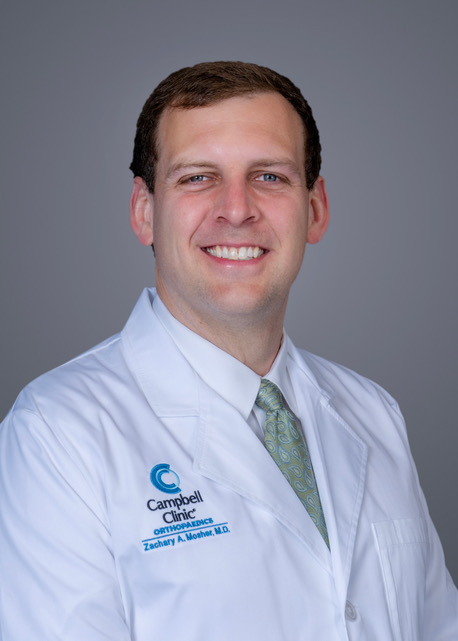
Zachary A. Mosher, M.D.
Hip & Knee Orthopaedic Surgeon | Specializing in Primary and Revision Joint Replacement, Robotic Surgery, and Minimally-Invasive Techniques | Restoring Function and Reducing Pain
Locations
Specialties

Areas of Expertise
- Complex hip, knee, and shoulder arthroplasty/replacement
- Minimally-invasive direct anterior total hip arthroplasty
- Quad-sparing total knee arthroplasty
- Partial knee arthroplasty
- Knee replacement
- Hip replacement
- Shoulder replacement
- Robotic joint replacement and robotic arthroplasty
- Revision joint replacement
- Fracture Care
Relief for Joint Pain Starts with the Right Plan
Schedule your visit with Dr. Mosher for personalized care designed to restore movement and reduce pain in your hips, knees, and joints.
Same-Day & Next-Day Appointments Available
Media

FAQs
What can I expect when you perform my knee replacement surgery?
Knee replacement is one of the most common orthopaedic surgeries performed in the United States and is only increasing due to the rise of patients being diagnosed with knee arthritis, and the improvement in the implant design, function, and longevity. The goal of knee replacement is to improve patients’ quality of life, alleviate pain, and improve function. Knee replacement is used to alleviate symptoms in patients with knee osteoarthritis, rheumatoid arthritis, osteonecrosis, and post-traumatic arthritis.
Dr. Mosher performs both traditional total knee replacement and partial knee replacement, depending on the patient’s goals and level of degenerative changes. He also uses the traditional medial parapatellar approach and quad-sparing approaches to the knee.
The ultimate goal of knee replacement is getting patients to what they want to do without pain, he we will slowly release restrictions on patients, and will allow them to get back to running, cycling, rowing, playing competitive sports, heavy labor, and more if they desire. However, his goal is for ALL patients to be walking and climbing stairs withing hours of surgery. This early mobilization allows for rapid recovery and early discharge, which improves outcomes, patient satisfaction, and patient safety.
Dr. Mosher prefers to give his patients a “multimodal” pain control regimen to control pain, while limiting the amount of harsh, narcotic pain medications to minimize medication-related complications and dependency.
He also may use robotic assistance or computer navigation during surgery to ensure that component placement is appropriate in an effort to boost patient satisfaction. While this technology continues to advance, it remains in its infancy. So, this is something that he will continue to monitor over coming years to improve patient outcomes. However, if patient’s desire robotic assistance, he is more than happy to perform these surgeries with a robot.
Watch videos of both a partial and total knee replacement from the American Association of Hip and Knee Surgeons (AAHKS).
What can I expect when you perform my hip replacement surgery?
Hip replacement has been hailed as the “operation of the century” by many academics due to its excellent outcomes and the durability of the implants. The ultimately goal of hip replacement is to get patients back to doing what they want to do—whether that be a 40-year-old firefighter vs an 80-year-old grandmother. Hip replacement is the final treatment for hip osteoarthritis, avascular necrosis, and some fractures.
Hip replacement replaces the ball and socket of your hip joint with an artificial joint made of titanium, plastic (polyethylene), and ceramic. Note, the articulation is ceramic on plastic, and no metal-on-metal implants are used.
Dr. Mosher predominantly uses the direct anterior approach to the hip with the traditional longitudinal incision or the bikini incision. He also uses the posterior approach for certain patients and indications where it would give improved outcomes, ease the surgery, or be safer.
The ultimate goal of hip replacement is getting patients to what they want to do, so Dr. Mosher will slowly release restrictions on patients, and will allow them to get back to running, cycling, rowing, playing competitive sports, heavy labor, and more if they desire. However, his goal is for ALL patients to be walking and climbing stairs withing hours of surgery. This early mobilization allows for rapid recovery and early discharge, which improves outcomes, patient satisfaction, and patient safety.
Dr. Mosher prefers to give his patients a “multimodal” pain control regimen to control pain, while limiting the amount of harsh, narcotic pain medications to minimize medication-related complications and dependency.
He also uses computer navigation during surgery to ensure that component placement is appropriate, yielding higher patient satisfaction.
Watch videos of both an anterior approach and posterior approach hip replacement from the American Association of Hip and Knee Surgeons (AAHKS).
What can I expect when you perform my shoulder replacement surgery?
Shoulder replacement and reverse total shoulder replacement are some of the fastest growing surgeries in popularity in the United States. The total shoulder arthroplasty is used for only osteoarthritis, while the reverse total shoulder is used for both osteoarthritis and chronic or irreparable rotator cuff tears. The reverse total shoulder is a relatively new procedure that takes away the importance of the rotator cuff and gives function to patients with debilitation of chronic or massive rotator cuff tears. In patients over 65 years of age, repairing rotator cuff tears is often a long, painful process without a guarantee that the repair will hold. The reverse allows a somewhat smoother recovery without worrying about the cuff repair. However, there is a tradeoff of slightly decreased range of motion.
With a shoulder replacement, the goal is to obtain a functional, pain-free shoulder. However, this is not a normal shoulder, so the range of motion will be slightly less, and Dr. Mosher does recommend holding off on body building. However, he routinely expects patients to get back into high activity level jobs after replacement.
What can I expect when you perform my robotic joint replacement surgery?
An emerging practice in the field of joint replacement is the use of robotic technologies to assist the surgeon in the joint replacement. These are predominantly used in partial and total knee replacements, and computer navigation is used predominantly with total hip replacement. For total knees, Dr. Mosher is happy to use this technology if a patient requests. For total hips, he will use computer navigation as a standard measure.
The goal of robotic assistance with partial and total knee replacement is to limit soft tissue dissection at the joint line and do a majority of the correction with saw cuts—which are based on intraoperative registration and sometimes even a preoperative CT scan. There are multiple robots available for use, and each major implant company has their own. Dr. Mosher is trained specifically for their use in this area. Notably, Dr. Mosher will still be doing the surgery, but the robotic arm and associated computer program will be assisting with guiding the saw cuts.
Notably, the use of robotic technology with total knee arthroplasty requires the usage of pins either inside or outside the incision in both the tibia and the femur. This does introduce the small, but present, unique risk of fracture at the pin site after surgery. No research has shown any definite benefit to patient outcomes after use of robotic assistance vs. conventional instrumentation. However, some studies have hinted to decreased early postoperative pain, better early range of motion, and possibly lower revision rate—though many of these studies are also loosely funded by robotic implant manufacturers.
For total hip arthroplasty, no arm will be used, but computer navigation will be used with fluoroscopy to confirm that the components are in appropriate position with acceptable restoration of limb length and offset.
For specific questions, Dr. Mosher will speak to you in clinic at our Campbell Clinic Southaven or Campbell Clinic Arlington locations prior to surgery scheduling.
Watch a video regarding robotic and computer navigation in joint replacement surgery from the American Association of Hip and Knee Surgeons (AAHKS).
What can I expect when you perform my revision joint replacement surgery?
Patients need revision surgery for a multitude of reasons, including infection, fracture, component malposition, stiffness, instability, bone loss, component loosening, etc. These surgeries are more involved and extensive than primary joint replacement. However, our goals remain the same—to get patient’s back doing the things they want to do.
For these surgeries, Dr. Mosher does change some of the protocols given that this is not a first-time surgery and there is a higher risk of complications. Even then, his goal is for patients to be up and moving within hours of surgery to improve outcomes, satisfaction, and safety. He still pushes mobility, even if he is limiting weightbearing on the affected extremity.
For revision hip replacement, Dr. Mosher uses both the anterior and posterior approach, depending on the reason for revision and the prior surgical approach. For revision knee replacement, Dr. Mosher uses the traditional medial parapatellar approach or the less-invasive quad-sparing approach.
- Read an article about manipulation under anesthesia from American Academy of Orthopaedic Surgeons (AAOS).
- Read an AAOS article or American Association of Hip and Knee Surgeons (AAHKS) article about revision total hip replacement.
- Read an AAOS article or AAHKS article about revision total knee replacement.
- Read an AAOS article about fracture following total hip arthroplasty.
What can I expect when you perform my fracture care?
Fractures are one of the most common urgent orthopaedic complaints that we see. The challenge of fractures in comparison to our other problems that we treat is that no one ever plans to get a fracture. While patients frequently plan months ahead of time regarding joint replacements, fractures are a sudden, sometimes life-altering change of plans. Dr. Mosher’s goal with fracture care is to get you back to the desired activity level. Admittedly all fractures are not created equal, with some being amenable to nonoperative management, others always require surgery. Furthermore, some fractures lead to significant loss of function, while others heal perfectly. No two fractures are the same, thus no two treatments are the same either.
Regardless of type or location of fracture, his goal is to get you back to the activities you enjoy. While this may take time, he will work with you through the entire process. Some fractures may even require multiple surgeries to fully address, and he will be here along the way.
Dr. Mosher understands that fracture care is often a frustrating experience—no one ever plans to be injured. However, he will work with you every step of the way. He will discuss the risks, benefits, and alternatives of any fracture treatment option in an effort to ascertain if operative or nonoperative treatment is best for you. Dr. Mosher performs fracture care at Campbell Clinic Southaven and Campbell Clinic Arlington in the inpatient and outpatient setting. Dr. Mosher treats all fractures from the toes to fingertips—excluding spinal fractures—and looks forward to getting you moving towards better health.
Helpful AAOS Links for Bone Health
- Activity, bone health, and joint health
- General bone health information
- Calcium correlating with bone health
- Exercise and bone health
- Bone health across all ages
- Hip fracture prevention
- Osteoporosis prevention and tips for bone health in childhood
- Preventing falls
- Vitamin D supplementation
- Fractures and broken bone healing
Helpful AAOS Links for Fracture Care
- Casting and internal fixation information
- Different imaging modalities
- Shoulder trauma, sling use and driving, clavicle fractures
- Hand fractures, finger fractures, and thumb fractures
- Toe and forefoot fractures, turf toe
- Hip fractures, femur fractures
- Ankle fractures, pediatric ankle fractures
- Distal humerus fractures, radial head fractures, olecranon fractures
- Broken wrist (video), wrist fractures, scaphoid fractures
- Forearm fractures
- Patella fractures, proximal tibia fractures, distal femur fractures, tibia fractures
- Stress fractures (general), foot and ankle stress fractures
How should I prepare for my joint replacement surgery?
Joint replacement surgery is a BIG deal and a large undertaking for the patient, friends, and family. This is a time to lean heavily into your support group. However, preparing appropriately prior to surgery can lead to success afterwards.
Dr. Mosher recommends seeing your primary care doctor prior to surgery to ensure that you are medically optimized for surgery to enhance your recovery.
He also recommends eating a balanced diet prior to surgery with an emphasis on healthy foods, protein, and balanced carbohydrates. He also recommends considering Vitamin D supplementation to improve bone health.
Daily, healthy exercise is critical prior to surgery. Though you obviously have some limitations due to joint pain, Dr. Mosher does recommend light aerobic activity and gentle stretching exercises, which can improve postoperative outcomes and expedite your surgical recovery. Common exercises are walking, gentle biking, and aquatic therapy activities.
Restrictions for Surgery
Surgery can be a great assistance to patients. However, it is critical to mitigate risk when possible. Thus, Dr. Mosher does have restrictions for candidates for total joint replacement. First, if you have poorly controlled medical conditions (diabetes, hypertension, heart disease, active infection, etc.), he must delay surgery and have you become medically optimized prior to surgery.
However, he does not have a BMI restriction. In lieu of losing weight prior to surgery, he recommends attempting to eat a balanced diet. However, beyond this, he does not have strict restrictions for operative management (including weight) and believe in an evaluation of the entire patient.
Professional Info
Auburn University
Med School: University of Alabama School of Medicine, 2018
Residency: Orthopedic Surgery Residency at University of Tennessee-Campbell Clinic, 2023
Fellowship
Adult Hip and Knee Reconstruction, Anderson Orthopaedic Clinic, 2024
Joined Staff
April 2026
Zachary A. Mosher, MD is a fellowship-trained orthopaedic surgeon with a special interest in complex primary and revision hip and knee replacement, partial knee replacement, minimally invasive hip and knee replacement, prosthetic joint infections, periprosthetic fractures, and fractures around the hip and knee. He is a native of Elkmont, AL, and obtained a Bachelor of Science in Biomedical Sciences from Auburn University graduating as an honors scholar with Summa Cum Laude recognition.
He then attended the University of Alabama School of Medicine and split time between the Huntsville and Birmingham campuses. During his time in medical school, he was inducted into the Alpha Omega Alpha and Arnold P. Gold Humanism medical honor societies and graduated with Magna Cum Laude recognition. He then completed an orthopaedic surgery residency at the renowned University of Tennessee-Campbell Clinic in Memphis, TN, where he worked with leaders in the field of orthopaedic surgery. Dr. Mosher completed his training with an adult hip and knee reconstruction fellowship in Alexandria, VA at the Anderson Orthopaedic Clinic, learning from pioneers in the management of complex hip and knee replacement.
Dr. Mosher predominantly uses the direct anterior approach to the hip with both traditional and bikini-based incisions. He also uses both traditional and quadriceps sparing approaches to the knee. Dr. Mosher employs the latest technology and innovation to help his patients, including both computer navigation and robotics. He is well versed in outpatient joint replacement. Additionally, Dr. Mosher has extensive training performing joint replacements in obese patients, treating periprosthetic fractures, complications from prior hip and knee replacements, infected joint replacements, and painful hip and knee replacements.
Beyond his specialization, Dr. Mosher exhibits a keen interest in general orthopaedics, encompassing primary and revision shoulder replacements, knee arthroscopy, complex fracture care, and comprehensive treatment of adult and pediatric patients for orthopaedic issues spanning from toes to fingertips. He recognizes the importance of transparent communication with patients and values open, honest discussions. Embracing both conservative and operative approaches, Dr. Mosher guides patients in determining the most suitable option for their unique needs, striving to create a personalized treatment plan tailored to each patient.
Dr. Mosher is a member of the American Academy of Orthopaedic Surgeons, the American Association of Hip and Knee Surgeons, the Engh Society, and the Willis C. Campbell Club. In his spare time, Dr. Mosher enjoys running, reading, spending time with family, and Auburn sports. Dr. Mosher and his wife, Erin, both grew up in North Alabama, and are excited to raise their daughters in this amazing community.
Professional Societies
Honors & Awards
- Summa Cum Laude, Auburn University
- Magna Cum Laude, University of Alabama School of Medicine
- Alpha Omega Alpha Medical Honor Society
- Arnold P. Gold Humanism Honor Society
Clinical & Research Interests
- Complex primary and revision hip and knee replacement
- Partial knee replacement
- Minimally invasive hip and knee replacement
- Adult hip and knee reconstruction
- Complex hip and knee replacement
- Traditional and quadriceps sparing knee replacement
- Outpatient joint replacement
- Infected joint replacements
- Primary and revision shoulder replacements
- Knee arthroscopy
- Complex fracture care
- Complex hip, knee, and shoulder arthroplasty/replacement
- Minimally-invasive direct anterior total hip arthroplasty
- Quad-sparing total knee arthroplasty
- Partial knee arthroplasty
- First-time and revision hip, knee, and shoulder replacement
Advanced Techniques / Technologies Used
- Direct anterior approach to hip replacement (including bikini incision)
- Quadriceps-sparing knee replacement techniques
- Minimally invasive joint replacement surgery
- Computer navigation
- Robotic-assisted surgery
- Outpatient joint replacement
- Joint replacement in obese patients
Get Back to the Life You Want to Live
Schedule an appointment with Dr. Mosher for expert care that guides you from diagnosis through total joint replacement surgery and back to the activities you enjoy.